Friday, February 14, 2014

Hedge fund blog

Hedge fund, a long only manager and a passive pusher are flying in for an institutional investor beauty parade in New Zealand. As the plane lands they see one purple sheep in a field.

Professor Passive says "All kiwi sheep are purple! I must buy them all now. At any price the farmer asks, no matter how expensive. No need to know the sheep's business or earnings. Forget about analysis or due diligence. Ignore risk! Prices are always correct because markets are efficient. It's not my money. I have academic tenure and a Nobel prize. Risk free...for me. An index tracking firm pays me outrageous fees to push "cheap" high risk unskilled toxic waste."

Long only manager says "Some kiwi sheep are purple but the professor says they all are. I am benchmarked to the index so I must also buy that sheep regardless of price or valuation. Can't risk tracking error or not being fully invested as pension consultants will remove me from their recommended list. It's not my money either. I get paid whether clients win or lose."

Hedge fund blog says "No asset can ever be bought without regard to price. I invest as a prudent man does. You guys are breaking ERISA law and belong in jail. Doing no analysis before making a purchase for fiduciary clients is an outrageous fraud. What are the fees your clients pay getting for their money?

One sheep might be purple. Most of my clients are retirees, widows, orphans and foundations serving good causes so I MUST do more analysis than you guys. Interests are aligned as all my savings and my family and friends' money is in the fund. I analyze potential investments very closely. It's true fiduciary duty. I'm ONLY paid well if I make money for clients.

There seems to be a sheep, one side of which appears to be temporarily purple. This may be due to chemicals in the sheep-dip, an accident with dye or paint, an optical illusion, a practical joke or a smudge on the airplane window. I will closely study sheep fundamentals and talk to many shepherds, shearers and wool merchants.

My quant team will gather extensive ovine data and conduct rigorous statistical analysis, mathematical modeling, stress tests and scenario simulations. Perhaps, after exhaustive research, I might be able to decide whether to short sell or even buy that apparently purple sheep, depending on its value.

The university endowment of Professor Passive is a client as well as the Nobel Foundation and long only dude's pension plan. They need the absolute returns I deliver because you can't buy food, pay faculty or meet liabilities with relative returns in bear markets. Passive's employer doesn't invest a cent in his beloved index funds. Too risky and too expensive."

Which fund would YOU invest in? Who should get the mandate? Who is most likely to generate the most RELIABLE risk-adjusted returns? Whose fees represent the best VALUE for the work? What manager is the "cheapest"? 

Would an investor truly following the prudent man rule really choose an index fund given the fiduciary duty for due diligence in selecting appropriate investments for beneficiaries? Passive funds that do no security analysis or risk management are a clear breach of fiduciary duty.

Which fund offers alignment between client and manager interests? "Cheap" index funds are the joke. The more conservative you are the more you need in proper hedge funds.
via:http://hedgefund.blogspot.in/2005/09/hedge-fund-blog.html?utm_source=feedburner&utm_medium=feed&utm_campaign=Feed:+HedgeFund+(Hedge+Fund)

George Soros fund

Warren Buffett and George Soros invest their wealth only in absolute return strategies. Past performance predicts the future if and only if the manager has skill. One counterexample suffices to destroy the absurd efficient market dogma and passive index mania. I've invested client capital in so many counterexamples. The "average" is no place for YOUR money.

Mid-career professionals like Warren and George are thriving while hedge fund managers aged under 80 gain experience. Over 41 years and net of fees George has turned $1,000 into $14 million and Warren to $3 million from his actively managed closed end fund. He charges less fees than unskilled index funds and his hedge fund is available to anyone. 

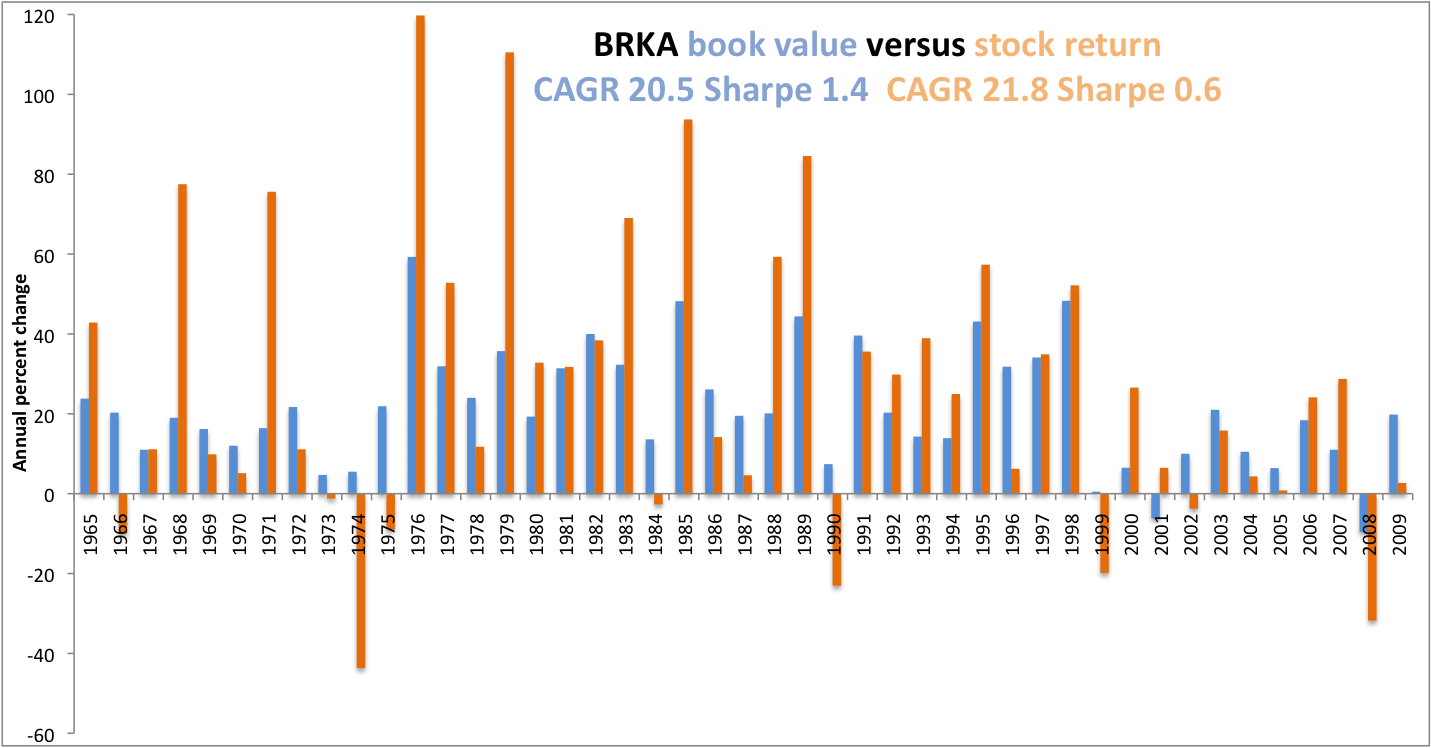
Here's George's versus Warren's track records since 1969. I use actual returns for Soros and BRKA. Warren prefers book value but that is not the correct way to assess his performance. Limited partnerships like George's are valued at NAV. Warren's listed hedge fund means shareholder sentiment also affects returns. BRKA stock price is more accurate.


Warren is correct that the best investment book in english is "The Intelligent Investor". The runner up is "Alchemy of Finance" though fortunately hardly anyone else tries to understand it, creating an edge for those that do. Top finance book in any language is Fountain of Gold, written by the best hedge fundmanager ever. If you master every page of all three, as I have, you will generate higher risk adjusted returns than 99% of investment "professionals". Rounding out the top financial books are "Tunnel Thru the Air" and "Tartar Steppe". No MBA or CFA class studies them.

Warren Buffett runs the Berkshire Hathaway hedge fund. George Soros is the top performing living hedge fund manager. The optimal portfolio is investing 100% in talent and 0% in asset classes or funds that depend on asset class direction. The worst portfolio is anything advocated by Burton Malkiel or Jack Bogle. Don't fight the Fed and don't fight Warren. He is 100% invested in hedge funds. So I do the same.

Warren made money for clients every year of 1960s but George produced absolute returns every year of 1970s, a more difficult decade. In due diligence I haven't found anyone else that was able to do that. Warren has delivered a lot of alpha but George made more. We can all be thankful to both of them for destroying the efficient markets hypothesis and the dangerous passive fad. Don't random walk your way to poverty.

While Paul Samuelson, Eugene Fama, William Sharpe, Robert Merton, Harry Markowitz, Myron Scholes and other "Nobel" prize "winners" were cooking up infamous "models" for portfolio "optimization" and how markets supposedly moved, REAL WORLD practitioners George and Warren knocked the cover off the ball making a mockery of inbred academic stupidity. Follow the doers not clueless theorists on tenured salaries. 

Samuelson set economics down the pathetic path it has taken since 1950s. True economists Adam Smith, Arthur Marshall and Keynes must be spinning in their graves at the damage that he and followers wrought. Passive pimps cite Samuelson's Challenge to Judgement in their ludicrous claim that no manager can beat the market. All he had to do was look at Warren or George's (or John Templeton, Benjamin Graham, Ed Thorp, Munehisa Honma etc) track record. But he didn't. Why let the FACTS destroy theory?

Investing in SKILL is the only prudent allocation. Talent and hard work are necessary to find alpha which is why so few managers produce it. Index funds charge outrageous fees for ignoring risk, doing no due diligence and just tracking someone's list of stocks. Why wouldn't you want your money managed by the best? Hedge fund managers never retire as the calling is for life. The only variable is which clients they accept. George now only manages for friends and family. Warren's hedge fund is still open to YOU.

Portfolio performance is determined by manager mix NOT asset allocation. The more people believing in efficient markets the more inefficient markets become. Trillions in index funds creates more alpha capture opportunities. Benjamin Graham ran the Graham-Newman hedge fund from 1920s. Warren short sold cocoa futures in a special situations deal as far back as 1954. He also got into insurance to access the float and not need to borrow from prime brokers. In due diligence, I found so-called "first" hedge fund A.W. Jones mostly front ran analyst upgrades so was NOT skill-based and would be illegal today.


If Berkshire Hathaway isn't a hedge fund then there are no hedge funds. Warren is mainly a derivatives and hybrids trader though he does hold a few core stocks as a hobby. "We have long invested in derivatives contracts that Charlie and I think are mispriced, just as we try to invest in mispriced stocks and bonds". Remember that when passive investing zombies claim active management and security analysis are "pointless".

Some people insult Warren by claiming he isn't a hedge fund manager! He focuses on absolute return and leverage, arbitrage, derivatives, event-driven and global macro have added heavily to his returns since inception.  One of the reasons most funds of hedge funds have abysmal performance is they ignore the best managers. I receive countless pitches from FOHF CIOs and salespeople. Unlike my hedge fund selection methods, none of them has allocated to Warren!

Where do you find great managers? It is possible to identify FUTURE winners in advance. George and Warren's edges were clear long ago so there was plenty of time to invest. Their success has brought major philanthropic benefits for global society and secure retirements for their clients. Price overshoots are PREDICTABLE. And profitable if you have expertise.

George and Warren generated high alpha from low frequency trading via various legal entities. Double Eagle - Quantum, Buffett Partnership - Berkshire Hathaway. Like many other hedge funds, they don't report returns to databases, only to clients. Neither has a PhD or CFA but both have exceptional quantitative skills. I have never found a good manager that doesn't, including if they run fundamental styles. Skilled managers do deliver reliable absolute returns and prove that market prices are NEVER correct.

George's track record is better but Warren is richer. Why? The snowball of POSITIVE compounding for longer. Both were born in August 1930 and Warren ran his hedge fund from 1957 but George didn't set up his until 1969. Warren was lucky to be in Omaha while Dzjchdzhe Shorash was in Budapest, more affected by WW2. Also Warren got into currency trading and philanthropy later. George's outperformance is due to more international diversification and because reflexivity is ignored. Value investing is copied more than reflexivity investing. The 2008 subprime credit crisis was a quintessential examples of reflexivity. 

The sad passive fad is reflexivity in action. So many securities' pricing behavior are now driven by indices NOT economics. Index funds buy stocks because they are on a list not after thorough analysis and due diligence. The difference between benchmark stocks and bonds and those not in a widely tracked index are very noticeable. Such predictability creates even more ineffficiencies for the skilled to monetize. YES beta leads to alpha. 

Warren ran a partnership from 1957-1969 and then implemented his strategies via Berkshire Hathaway. He first bought BRKA shares in 1962 at $7.60 and it's now $120,000 for a 22% CAGR. But the Buffett Partnership did better with all 13 years positive. Gross returns of 29.5% were net 23.8% to investors after his 25% incentive fee above 6% hurdle. What if, instead of "retiring" in 1970, Warren had continued the partnership and performance had persisted? Investing $1,000 in 1957 would now be $100 million. Fees that Warren might have been "paid" for turning $1,000 into $100 million would be $1 billion. That's good since clients would STILL have $99.9 million MORE than gambling on passive funds.


Warren, George and many others have destroyed efficient market hypotheses, random walk assumptions and the myth that asset allocation drives portfolio returns. BHB Brinson et al cost too many investors too much money and wrecked retirement plans, foundation spending and endowment budgets. In the real world fiduciary investors want ALL their capital in attractive opportunities and that requires skill. George and Warren's alpha capture from security selection worked better than static beta bets. No-one says it's easy but if you work hard it is possible as they have proved. Such teams CAN be identified at an early stage and charge whatever hedge fund fees clients are prepared to pay. 

Academics say Warren is just an ex-post lucky outlier but some spotted his talents ex-ante. Were they lucky too? The S&P 500 also began in 1957 but has performed terribly by comparison - $1,000 would now be just $100,000, huge opportunity cost and pathetic "compensation" for its risk. Investing for absolute return using competitive edges and outside the box thinking has existed for centuries. Long only relative return is the fad. Passive indexing is even newer. The trouble with owning dartboards is that you get the treble 20 but you also tie up precious cash in 1s, 2s and 3s. With proper analysis, average hedge funds can be avoided just like average stocks. I prefer to identify the Phil Taylor of each strategy. How many darts must you throw to show skill? George and Warren have hit many treble 20s.

Warren wants to be judged on book value not stock price but you can't eat book value and I evaluate fund managers by what investors really receive. Partnerships are marked at NAV but the switch to BRKA subjected clients to the irrational and highly inefficient public markets. In 2008 BRKA book value dropped -9.6% but shareholders lost -31.8%. George made money in that allegedly "challenging" year. While the stock has returned slightly more than book value due to the valuation premium, the volatility has been high. Warren's actual Sharpe ratio is lower than his book value "Sharpe ratio", dropping from 1.4 to just 0.6. Of course that is still much better than the high risk S&P 500. VFINX, SPY and its brethren have been disasters.


The Oracle of Omaha and the Brain of Budapest have "quit" before. George has hired "replacements" since 1981 and the extent of his involvement has fluctuated since though never without close knowledge of and implied oversight of the portfolio. For each Li Lu or Todd Combs there was a Jim Marquez or Stanley Druckenmiller. No man is an island and both sought out strong partners and talented employees from early on. Jim Rogers and Charlie Munger added significantly. Accredited investors - anyone with $80 - can access Warren and Charlie's abilities through BRKB, a listed closed-end fund. The active stockpickers at benchmark construction firms missed 45 years of massive growth but then add it to their "unmanaged" index!

Would Warren and George have bothered managing outside money if they hadn't been incentivized to do so and perform? It's skill that adds value. No alpha, no incentive fee. George's partnership fees were lower than Warrens's for gross returns above 25%. Since George and Warren's gross performance was in excess of 25%, George's fee structure was actually cheaper. Jim Simons and team have outperformed both for the past 20 years with much higher fees but the net returns of Medallion Fund were superior. The technological and personnel infrastructure requirements for high frequency trading cost more than for low frequency. If you don't like the fees, don't invest in hedge funds. Capacity for a good strategy is limited and demand exceeds supply of alpha. But it's expensive and dangerous waiting to find out WHETHER bargain beta might one day deliver.

Those "outrageous" fees? George charged 1% and 20% no hurdle whereas Warren charged 0% and 25% on 6% hurdle, then offered his money management skills for FREE in return for permanent, leveraged capital. But you would have done much better going with Soros Fund Management in 1969 and paying those "high" fees than you would with BRKA. I am delighted for people to be well compensated for delivering what I need, ABSOLUTE ALPHA, from their RARE abilities. If someone turns $1,000 into $100 million from skill not luck or riding the market, they deserve $1 billion. Especially when manager interests are aligned with clients by them being the largest investor in their fund. When George or Warren has a bad month, they PERSONALLY lose more than any client. That INCENTIVIZES them to do their best to minimize the downside.

This chart assumes fees compounded without the manager needing to eat, live, pay employees, run the business etc. which of course they do. In recent years, with investor demands for larger teams, deep benches and operational infrastructure, fixed costs for hedge funds have risen to the 2 and 20 mode. Two people, a computer and a phone do not get institutional money today. Sad though to see an Omaha pension fund deep in a $600 million deficit when they could so easily have hired a local hedge fund run by Warren Buffett to get them into surplus. The Hungary retirement system is not in good shape either but they could have invested with George Soros and would now be doing fine. Why avoid top absolute return managers when you have ABSOLUTE LIABILITIES to fund?

You can't eat relative returns but you CAN eat absolute returns and I'll take $100 million over $100,000 every time. I assume you would too. Sadly most "advice" focuses on asset allocation NOT manager selection. Save fees or upgrade skills? So what if the manager becomes a billionaire? They deserve it for the essential entrepreneurial service they offer. If clients get rich, it is fine by me if the manager gets richer. Plenty of "discount" funds are available but at what performance? Avoiding "high" fees for alpha is like saying to a Porsche dealer you will only pay $100 for a new car because that is what the raw materials cost. Or that Shakespeare was just a lucky fool who "randomly" chose words from the dictionary. I am writing this on Apple AAPL hardware using Microsoft MSFT software uploaded to a service owned by Google GOOG. Using those products may further enrich several people who are already billionaires. Does it matter? Or do SHARED incentives work? 

No-one is forced to invest in hedge funds. Investors are free to make do with passive beta and relative return if they can stomach the risk. I can't. Some even say alpha doesn't exist! If you flip a coin 10 times and get 8 heads it might be a fluke but NOT if you flip 1,000,000 coins and get 800,000 heads. Warren and George have flipped too many coins for their returns to be luck. They made their clients rich, deservedly got richer themselves and are giving their wealth away for the social benefit of the world. A rare financial win/win/win.
via:http://hedgefund.blogspot.in/2010/11/portfolio-manager.html?utm_source=feedburner&utm_medium=feed&utm_campaign=Feed:+HedgeFund+(Hedge+Fund)

Econ Summer Camp

Grad students with an interest in the history of economic thought should click here.
via:http://gregmankiw.blogspot.in/2014/02/econ-summer-camp.html

Sentence of the Day

CBO estimates that the ACA [Affordable Care Act] will reduce the total number of hours worked, on net, by about 1.5 percent to 2.0 percent during the period from 2017 to 2024, almost entirely because workers will choose to supply less labor—given the new taxes and other incentives they will face and the financial benefits some will receive.
Implicit in this estimate are elasticities that measure how much people respond to incentives.  My sense is that CBO is typically conservative when it come to gauging these incentives effects.  So I would take their estimate of the impact on hours worked as a lower bound. The actual figure may be higher.
via:http://gregmankiw.blogspot.in/2014/02/sentence-of-day.html

Solow vs Mankiw on the One Percent

Readers of this blog will be familiar with my recent articleDefending the One Percent.  In the new released issue of JEPyou can read a letter by Bob Solow commenting on the article as well as my response.
via:http://gregmankiw.blogspot.in/2014/02/solow-vs-mankiw-on-one-percent.html

The Economics of Downton Abbey

the economics department at Harvard University, where I teach introductory .
via:http://gregmankiw.blogspot.in/2014/02/the-economics-of-downton-abbey.html

If Obamacare reduces labor supply, will it raise wages?

In a couple of recent articles written by smart economists, I have read the following claim: CBO says the incentives in the Affordable Care Act will reduce labor supply. If it does, then real wages will increase.

That sounds like reasonable, textbook economics. But I don't think it is true. The problem is that the logic is entirely partial equilibrium. It is holding everything else constant. But that is surely not right in the long run. Lower labor supply means lower income, which means lower saving, which means lower investment, which means a lower capital stock, which means lower productivity, which means lower labor demand.

Perhaps the easiest way to think about this issue is in the context of a Solow growth model. In the Solow model, the steady-state real wage is a function of technology, the saving rate, and the population growth rate. If labor supply per person suddenly falls by, say, 2 percent and stays there, the real wage will rise initally, but it will eventually return to its former level. Steady-state income per person falls by the full 2 percent.

One effect that might occur is a change in the composition of labor income. If the Act reduces labor supply primarily among the low-skilled, while not having that effect among the highly-skilled, then we might get a change in the relative wages of skilled and unskilled. But an overall increase in real wages seems unlikely.
via:http://gregmankiw.blogspot.in/2014/02/if-obamacare-reduces-labor-supply-will.html

Sharing the wealth

ON SUNDAY this happened:
A narrow majority of voters in Switzerland approved proposals on Sunday that would reintroduce restrictions on the number of foreigners who are allowed to live and work in the country, a move that could have far-reaching implications for Switzerland’s relations with the European Union.
The foreign-born population in Switzerland is 27%, and Tyler Cowen reckons that probably functions as something of an upper limit for politically tolerable stocks of immigrants in a rich country. He adds:
One of my objections to the open borders idea is that I think it would be negative for sustainable, actually realized flows of immigration.
That anxiety seems misplaced to me. For one thing, "open borders" are pushed by a relatively small intellectual elite. While I'm sure most of that elite would like to see truly open borders, their rhetorical efforts are probably better understood as an effort to shift the window of possibilities among influence-able decision-makers toward generally more open immigration regimes. We can wring our hands over unanticipated side-effects of open-border policies when they threaten to become reality.
I'd also argue that we shouldn't take attitudes on the subject as fixed. Views on the desirability of immigration are anything but uniform across the world. Americans seem generally fine with a foreign-born population of around 12% of the total while Japan has a foreign-born population of under 2%. The perceived "otherness" of some kinds of immigration can change dramatically over time. Americans once had fairly retrograde views on migrants from the European periphery: groups that would scarcely be considered immigrants at all today. These things are not immutable.
I'm more interested in, and perhaps worried by, the (possible) interaction of the Swiss immigration vote with a fledgling movement within Switzerland for a universal basic income.
The basic income plan is anything but a sure thing, and residence does not equal citizenship. But at a time at which economic conditions—like stagnant wages, falling employment rates, and declining labour share of income—make extension of the safety net look reasonable, a large foreign-born population may come to look like an obstacle to such extensions: either because making the safety net available to migrants is socially and financially impractical or because the idea of a second class of poor migrants is unappealing.
One might just as well argue that in countries like Britain and America, universal basic incomes look roughly as realistic a possibility as open borders, and so it might not be worth stressing about the interaction between the two policies. But it is something to keep an eye on. It will probably seem much easier to invite in migrants when the invitation means little in the way of obligation for those already in the country.
via:http://www.economist.com/blogs/freeexchange/2014/02/immigration

The disruption to come

THIS week's Free exchange column looks at the economics of online higher education:
Two big forces underpin a university’s costs. The first is the need for physical proximity. Adding students is expensive—they require more buildings and instructors—and so a university’s marginal cost of production is high. That means that even in a competitive market, where price converges towards marginal cost, modern education is dear.
It is also hard to raise productivity. University lecturers can teach at most a few hundred students each semester—the maximum that can be squeezed into lecture halls and exam-marking rosters. Because it is so labour intensive higher education relies on large numbers of instructors paid relatively modest salaries.
MOOCs work completely differently. Alex Tabarrok, an economist at George Mason University and co-founder of an online-education site, Marginal Revolution University, reckons the most salient feature of the online course is its rock-bottom marginal cost: teaching additional students is virtually free. The fixed cost of creating an online course is relatively high, however. Getting started means putting together a curriculum, producing written and recorded material to explain it, and creating an interactive site that facilitates discussion and feedback.
Having invested in the production of a course, a provider’s incentive is to sell it to as many students as possible. After the initial cost is covered each additional unit sold is pure profit. A low price maximises registrations and profit. But as prices converge towards marginal cost, there will be little scope for undercutting the competition. Instead MOOCs are likely to compete on quality, Mr Tabarrok reckons. Higher production costs are a small price to pay to attract much greater numbers of students. Such markets often evolve into winner-take-all, “superstar” competitions. The best courses attract the most customers and profit handsomely as a result. In this respect online education may more closely resemble information industries such as film-making than service industries such as hair-cutting.
The piece goes on to discuss how these economics might affect the business models of different sorts of institutions of higher education: of less-selective schools versus highly selective schools, for instance. Building on the discussion in the piece, economist John Cochrane, of the University of Chicago, offers a very interesting take on "Mooconomics" building on his own experience putting together online courses. It's not an easy post to summarise and I recommend you read it for yourself. But here is one clear takeaway:
On these dimensions, online is about halfway. The forums, google chats, and growing community between students are not as good as a high quality classroom experience. They are much better than a mediocre class at a university in the middle of nowhere.
Many of those who get paid money to think and write about these issues were educated at top universities. Their experience is one in which peers are highly motivated and interested in the course material, in which there is a high level of interaction between students and with top faculty, and in which both learning for its own sake and a research mission are considered vital parts of the university model. For people educated in that environment, the MOOC model looks like a woefully inadequate replacement for existing modes of higher education.
But that is not remotely the median experience in higher education. Many more students (in America, at least, and probably elsewhere) have a very practical view of the benefits of higher education, are paying considerable sums of money to sit through mediocre lectures consisting of fairly standardised material, are going to school at irregular hours or intervals and are not interacting heavily with peers, and are dropping out of school at relatively high rates. For these students, the earliest online courses were "disruptive" in the sense that they offered an alternative that was not as good for a much, much lower price. But online offerings have very quickly evolved into something that is better right the way round, and which will only continue to improve.
Students will soon find that for very low prices they can get a much broader array of course choices, most of which offer superior instruction with much more flexibility: you can view the lectures when you want, as many times as you want, wherever you want. They may find that opportunities for interaction with instructors and fellow students are actually improved by the shift to online, because of the benefits of economies of scale and the gains from temporal and spatial flexibility. It will not be long before completion of particular MOOCs earn students enough credit at "real" universities to enable students to get a "real" degree. The stigma associated with MOOC learning should quickly flip to status signalling, since anyone who can do an entire degree online is probably disciplined and self-motivated.
It is very easy to see how elite universities survive this, as they provide a fundamentally different experience. It is equally easy to see how large segments of the world of higher education are rendered unnecessary: where, within a decade or two, all that will remain of hundreds or thousands of less-selective universities will be the buildings—and a skilled teacher or two who built courses that prospered in online markets.
That disruption will be very painful for many members of society, especially those who enjoy good salaries and high status teaching unremarkable courses at local universities. On the other hand, it will be a terrific boon for all those with a desire to learn. The spillover effects will carry well beyond the typical higher-education experience. Good, cheap online education will allow people of all walks of life all over the world to explore an enormous range of topics. Interested secondary school students will have no reason not to take university courses in economics. Middle-aged professionals can dabble in everything from computer science to explorations of 18th century Baltic poetry. One of the great advantages of online learning is the ability to work at massive scale, which makes production of courses studying the tiniest niche subjects economical.
There is also the distinct possibility that higher education will become even more of a critical American export than it already is. America will be able to sell its highly sought-after education services to even more of the world. Of course, there will also be few barriers to entry to talented course producers in Britain or Singapore or anywhere else. But high fixed costs suggest there may be a first-mover advantage. It will also be fascinating to see how geographical clustering of the Mooc-making industry evolves. American higher education is very geographically dispersed at the moment, but we tend to observe high levels of geographic concentration in tradable industries. Which cities will serve as the Hollywood of online education?
What will be interesting to observe, in the near term, is where the two worlds meet and what happens at that juncture. How far down the ranks of American universities will "elite status" protect current business models? Beyond the top 20? The social shock of the arrival of online education will be substantially greater if it devours the top echelon of public universities.
There are many unknowns where higher education is concerned. But with the MOOC experience rapidly overtaking, in quality, the standard education at non-selective universities, dramatic change now looks inevitable.
via:http://www.economist.com/blogs/freeexchange/2014/02/online-education

The indignity of no work

RECENT discussion over the labour-supply effects of Obamacare has touched off a debate over the usefulness of the dignity of work as a social value. Leading Republicans argue that policies that discourage work and therefore signal that work is not important should be strongly resisted. Paul Krugman insists that it is impossible to maintain the illusion of the dignity of all work when financiers bring home incomes vastly larger than those earned by the typical worker, all while adding dubious value to the economy. Kevin Drum issympathetic to Mr Krugman's arguments, but says Democrats should nonetheless avoid the temptation to play down the importance of the dignity of work:
I really hate to see liberals disparage the value of work, even if it's only implicit, as it is here. Even people who hate their jobs take satisfaction in the knowledge that they're paying their way and providing for their families. People who lose their jobs usually report intense stress and feelings of inadequacy even if money per se isn't an imminent problem (perhaps because a spouse works, perhaps because they're drawing an unemployment check). Most people want to work, and most people also want to believe that their fellow citizens are working. It's part of the social contract. As corrosive as inequality can be, a sense of other people living off the dole can be equally corrosive.
A world in which a healthy adult has the reasonable expectation of earning a decent living while working full-time at a market wage is absolutely a world in which the dignity of work is a useful social value to cultivate. In a world in which that is not a reasonable expectation, the dignity of work can be a harmful concept. Society would effectively be kicking people while they are down; in addition to the hardship involved in un- or underemployment and poverty society would demand that the workless individual feel shame at his or her inability to function as a valued member of society.
Looking around, it seems difficult to argue that most of those struggling to get by without adequate work or on meagre wages are shiftless, or simply fail to appreciate the psychic benefits of working for a living. Maybe involuntary underwork is just a symptom of the current, post-crisis recovery, and it is worth protecting the dignity of work as a social norm since eventually labour markets will be back to normal.
But maybe we will not be returning to normal. Maybe technological change will force a large share of the population to get by with too little to live on—or too little to live on relative to average earnings to be politically sustainable. Maybe reduced labour demand can then be accommodated by reducing workweeks and topping up wages, allowing society to retain the dignity of work as a useful concept. Yet even in that case the amount of leisure time will grow. And even work sharing may leave many people without paying work.
In that case, the dignity of work may cease to be a particularly useful social concept, and something will be needed to replace it. Society will have to come up with new means to set useful incentives for people in a world in which we do not allocate purchasing power through market wages. We might talk instead about the dignity of endeavour for its own sake, or the dignity of contribution to society. Such phrases may seem to have the makings of a social infrastructure for socialism. Indeed they do, for a world in which machines can do much of the work will need to become more socialistic if it is not to become intolerably unequal.
The dignity of endeavour for its own sake could be a useful way to encourage people to use masses of leisure time in socially beneficial ways. That could mean operating a local business that customers enjoy but which only manages to cover its costs. It could be producing artisanal or craft goods. It could be practicing citizen journalism: spending time covering local government doings and then writing up one's findings on a free blog. It could be volunteering to work at an animal shelter. Not everyone will opt to use leisure in such ways; many will play video games or drink. That's their right.
But the broader point is that those now questioning the utility or relevance of the concept of the dignity of work are responding to reality. They are not so much pushing people away from work as acknowledging that work has moved away from people. Economies that have relied on market wages to provide incentive structures for people for centuries (with a dash of dignity of work and other social norms thrown in) are going to have to change.
via:http://www.economist.com/blogs/freeexchange/2014/02/social-norms